Search Ubuntu related information and How to with UbuntuWire.com

I just found out from Brandon Holtsclaw’s blog that he started a project named UbuntuWire for the benefit of Ubuntu users.

UbuntuWire is a specialized Ubuntu search engine which can help you find information related to Ubuntu operating system quickly without having to wade through countless unrelated websites on the internet. The search engine is powered by by Google Custom search and only takes result from reliable/official Ubuntu websites.

Alternatively you could try Uboontu which performs the exact same functionality as UbuntuWire but with different UI presentation.

Hope that would help you shorten your work when you’re searching for Ubuntu related information.

[tags]ubuntu,debian.linux,opensource,open source,gutsy,gutsy gibbon,howto,guide[/tags]
How to Burn and Normalize MP3 to Audio CD in Ubuntu Linux

The most usual (and popular!) way to create a “mixed-tape” Audio CD is to burn it from a collection of MP3 song taken of several sources.

However as these mp3 are ripped from several sources, there would be inconsistencies of the volume loudness which would create an annoyance if one had to readjust the CD player volume from song-to-song.

A “Normalization” process would automatically fixed the audio so that all song would have the same amount of volume, but sadly the default Serpentine Audio CD creator that comes with Ubuntu does not support normalization.

How to Normalize MP3 song
First of all open a terminal and install normalize-audio package :

sudo apt-get install normalize-audio

Then change directory to your mp3 collections to be burned and execute:

normalize-audio -m -v  *.mp3

normalize-audio will then compute the files level one-by-one and then will apply normalization on all mp3 files.

You can then use your favorite CD burner application (like Serpentine) to burn the normalized MP3 files to make an audio CD.

normalize-audio also supports ogg files for normalization.

Happy burning!

[tags]mp3,audiocd,burning,cd burn,audio cd,ogg,vorbis,opensource,open source,gutsy,gutsy gibbon,ubuntu[/tags]

Track Amateur Radio Satellites with Gpredict in Ubuntu Linux

Amateur Radio Satellites or OSCARs are a series of satellites orbiting earth that uses Amateur Radio Frequency band to facilitate long range communication between earth base stations.

However these satellites are not in synchronous orbit with earth, meaning that their location changes over time when they orbits earth. A satellite would only cover certain areas in just under an hour!

GPredict Satellite Tracking Software
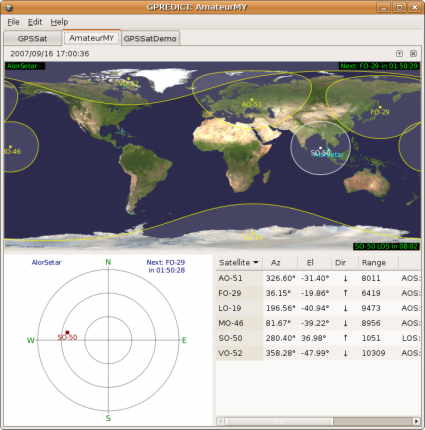
Fortunately, Linux users can track various types of satellite including OSCARs that orbits earth with GPredict. The software itself is easy to use, at most you just need to specify the coordinate of your base station on earth and select which satellite you want to track via GPredict.

GPredict will then will shows its tracking result on the screen along with the satellite footprint as a guidance for the users. GPredict also able to tell when a satellite come into view along with its ETA. This would help you prepare yourself for a QSO session using the satellite.

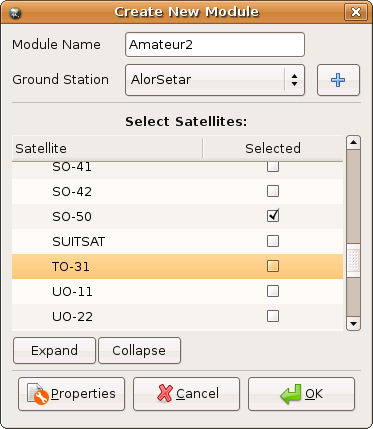
Heres a couple of screenshot of GPredict


GPredict is available for Linux,Mac OS, *BSD and Windows platform (experimental) from Groudstation’s project website.

Gpredict is also available straight from Ubuntu/Debian apt-get repository.

Some interesting reading from a guy who uses amateur radio satellites frequently to communicate – http://9w2cbl.blogspot.com

[tags]amateur, satellites, oscar, hamradio, ham, hobby, linux, open source,ubuntu,gutsy,gpredict,amateur radio[/tags]

How to Recover photo files from SD Card / MMC with PhotoRec

Among the main cause for loosing digital photographs are corrupted filesystems, and accidental SD card formatting. These photographs are still recoverable using photo recovery softwares available on the internet.

However, a quick survey on the internet reveals that most of the commercially available photo recovery software are either too expensive or is not available for Linux users.

How to Recover photo files with Photorec
Enter Photorec, a free and open source file recovery software from CGSecurity. As the name implies, photorec was originally developed to recover photo files from flash/memory card.

It has since been expanded to support more file types covering popular document files (doc,xls,mdb), archives (zip,rar,gz,bz2,tar) and multimedia files (mp3,wav,avi,mpeg).

Here’s how to recover your lost files using Photorec :

Continue reading “How to Recover photo files from SD Card / MMC with PhotoRec”

How to upgrade Ubuntu from Feisty Fawn to Gutsy Gibbon

The new release of Ubuntu 7.10 (Gutsy Gibbon) is just around the corner! It comes with a load of new features including :

  • Cool desktop effects with Compiz support out from the box
  • New Printing Service (Automatically setup connected printer)
  • Integrated Desktop Search with Tracker
  • Graphical X configuration tool, supports system with dual monitor
  • Fast User Switching
  • Latest XOrg and GNOME version

With all these new features and latest softwares from repositories, I think it makes no sense not to upgrade to Gutsy Gibbon unless if you don’t have a fast internet connection or way too crazy to upgrade.

How to upgrade to Gutsy Gibbon
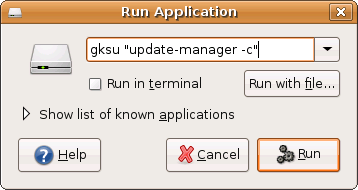
Upgrading to Ubuntu Gutsy Gibbon is painless. You only need to press “Alt-F2” from the desktop to launch the “Run Application” dialog, and type “gksu update-manager -c”.

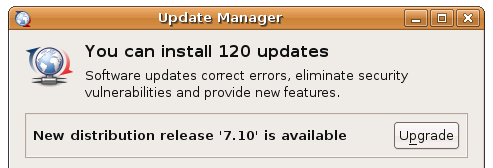
You will the be presented with this dialog

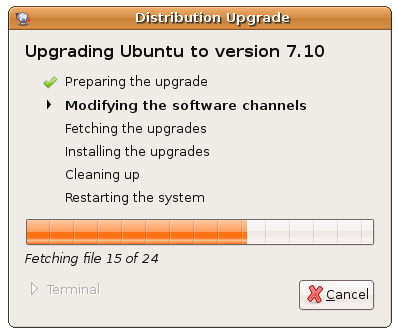
Press Upgrade and sit back, grab a cup of coffee while your Ubuntu operating system is being upgraded to Gutsy Gibbon.

That’s all, happy upgrading!

Note that Gutsy Gibbon upgrades will only be available on or after 18 October 2007, so stay tuned!

[tags]ubuntu,linux,debian,opensource,feisty,gutsy,gutsy gibbon,feisty fawn[/tags]