Generate Ubuntu apt-get Source.lst automatically

Sources.lst is a file located in /etc/apt/ directory. It is used in Debian-based (which includes Ubuntu) Linux operating system as a configuration file for software management.

Sometimes it is necessary to alter your sources.lst to include the nearest apt-get mirrors from your location, this is to ensure faster downloads during software upgrades and installations.

Fortunately, the good people from Ubuntu-NL has made this task easier by creating an online tool (source-o-matic) which helps you generate sources.lst file based on the list of available mirrors

source-o-matic supports Ubuntu releases on all architectures from 4.10(Warty) to 7.04 (Feisty). It is an easy tool to use, you only need to choose which country you’re in, put on your Ubuntu release and architecture, tick few radio boxes and your sources.lst file will be generated automatically.


Source-o-matic
also includes a list of unofficial apt-get mirrors for installing softwares that isnt included in the normal Ubuntu distributions.

[tags]ubuntu, linux, sources.lst,apt-get[/tags]

5 Things I hate about Ubuntu

I believe some of you have already read my blog and will summarize that I’m an Ubuntu user and advocator.

However, having said that doesn’t mean that I dont have things that I hate about Ubuntu, and they are :

  1. Windows manager (GNOME) is damn too slow compared with other distro
  2. Eats a lot of memory in desktop mode
  3. It has defective or near unusable packages (ie ffmpeg, scribus)
  4. Depends too much on internet connection for package installations and management
  5. Default installation does not include applications and codecs that I use most. I had to rely to the *internet* to get those apps installed (read above) (a small issue but an issue nevertheless)

Those are the 5 things that crossed my mind when I switched on my computer and use Ubuntu everyday. What’s yours?

[tags]ubuntu,debian,linux,opensource,distro[/tags]

How to secure your SSH server

I came across this interesting post about how to secure your SSH without changing the SSH listening port.

Things that the post author suggested are :

  1. Enforce the use of secure and hard to guess password
  2. Disable login by password, use Public Key Authentication for greater security.
  3. Allow SSH connection from trusted network only.
  4. Implement Port Knockinghttp://www.linuxjournal.com/article/6811
  5. Use iptables RECENT match to filter SSH scanners

Personally I’ve enabled public-key authentication and SSH scanner filter to secure my server at the advice of my friend from a local security firm. Although, I haven’t tried the port knocking method yet, it seems interesting to know that ‘secret port knocking’ pattern also exists in computer security (remember ali baba?)

Hopefully this post will serve as a reminder to myself and those who read them, ah oh, most of this post content are lifted shamelessly from False sense of security

[tags]ssh,iptables,ubuntu,debian,security, port knocking,nmap, security scanners,exploit[/tags]

http://blog.drinsama.de/erich/en/linux/2007021502-false-sense-of-security

Ubuntu apt-get easter egg trick

We may have been familiar with the usual apt-get operations for installing, updating and removing application packages on your Debian-base Linux operating system (Ubuntu is one of it).

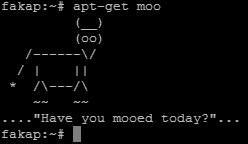
But do you know that you can trigger it to show a hidden easter egg?

try typing “apt-get moo” and see it for yourself :)

apt-get moo super cow powers

[tags]apt-get,debian,deb,ubuntu,knoppix[/tags]

Linux GTK+ 1337-generator : Text to Leetspeak converter

I found out about this application from GnomeFiles. Not particularly useful, but entertaining. The basic operation of the program is to convert plain text into leetspeak writing system.

Future releases may provide functionality to reverse leetspeak text back to plaintext for greater readability.

leet-generator-tn.png

1337 generator requires GTK+ 2.x and can be downloaded from http://leet-generator.sourceforge.net/

[tags]gtk+,1337,leet,ubuntu,linux[/tags]