‘barcode‘ is a utility in Debian GNU/Linux distribution used for generating common 1-D barcode: EAN-13, EAN-8, UPC, ISBN, code93, code128 & codabar.
barcode outputs file in postscript format which can be converted to PDF with the ‘ps2pdf‘ utility
Usage:
1. Outputs isbn barcode and converts it to PDF file
$  barcode -o barcode.ps -e isbn
$  ps2pdf barcode.ps
2. Outputs EAN-13 barcode
$ barcode -o barcode-ean.ps -e ean
If you are looking for a tool that could generate QR Code, then you can try ‘qrencode‘
The latest Ubuntu 12.04 LTS is going to be released in (28 April 2012), that is less than a week! The latest features of Precise Pangolin are:
1. Linux Kernel
Ubuntu 12.04 will use a kernel based on the 3.2.12 upstream Linux kernel, which include a patch that makes Linux powered laptop consumes more efficiently
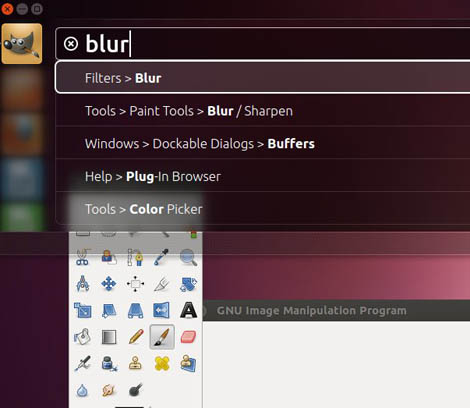
2. HUD – Intelligent search feature in Ubuntu 12.04
Stands for Heads-up Display, HUD can be used to search for items in the menu bar in most applications. For example, if you are looking for a particular menu (or functionality) in GIMP, but can’t quite recall its position, you can use HUD to search it. Pictured here here is an attempt to search for ‘Blur’ filter for GIMP.
Currently HUD only works with application that supported Global menu, which means you can’t use it in LibreOffice.
3. Rhythmbox replaced Bansee as the default multimedia player
A decision came during the last Ubuntu Developer Summit (UDS). This move is connected to the new community decision to remove Mono and any application that depends on it from the default installation.
Another casualty is Tomboy note-taking application and gbrainy (game) which also depends on Monoi
**personally, I find depending on Mono application could be problematic, moreover those applications aren’t taking advantage of the ‘portability’ of the .NET platforms (It can’t be used on Microsoft Windows either, not without extensive hacking). So what’s the use of including Mono application on Ubuntu, except for bloating distros?
4. Global Privacy Settings
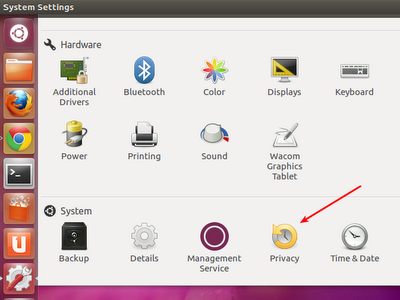
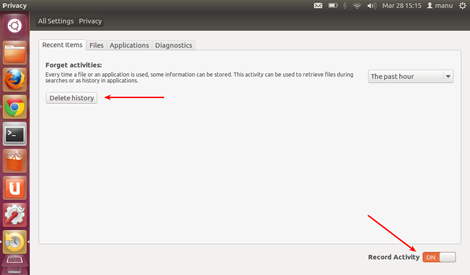
Ubuntu 12.04 LTS features “Privacy” option in the System Settings screen. The new Privacy Menu gives users the option of turning off History recording for users activities with a click of a menu.
Users may also disable activity recording for a specific group of applications (Instant Messaging, Web browsing, Office Documents, Emails and Multimedia), note that this option *MAY* only work on application that comes with Ubuntu default-installation.
5. Ubuntu *.ISO installer will exceed CD-ROM size
CD-ROM was used as installers on computer platform since 1994, back then the 650MB storage was larger than the average hdd capacity of around 320MB-500MB. The practice of releasing CD-sized ISO have since followed Linux distro for years, well after DVD drive and DVD-writers have become common.
Starting with Ubuntu Precise Pangolin (12.04 LTS), Ubuntu *.iso sizes will not fit CD-ROM anymore. it’s ISO size is estimated to be around 750MB to 800MB. Users may burn the ISO on DVD or use utilities such as UNetBootin to create bootable USB Drive.
My Thoughts
I think Ubuntu is going strong on this release with vast improvements on the usability, especially on the aspect of the UI user-friendliness to those who are new to GNU/Linux. However, I still thinks that Unity UI (and to the extend, the Ubuntu Software Center) is VERY SLOW even when running on a modern system as it took about 10 seconds to load Ubuntu Software Center.
Frankly, I think Ubuntu and the general GNU/Linux desktop community should improve the perceived latency of its UI first in order to persuade people to use open source operating system.
Free Software (or Open Source Software) aims not only to give the freedom to use software without restrictions, but also grants the user the freedom to modify, enhance and redistribute the modified code to others while simultaneously granting others the same freedom as well.
To this end, commercial companies have benefited from contributions made by online communities from all over the world on Free and Open Source Software, which some of the company gives back.
However there are also some quarters who are not prepared to face the reality of code forking, especially when the fork has the potential to compete with the original software.
RadioPlay is an only radio streaming player that runs on compatible Linux Desktop system tray. It feature an easy to use interface and only targets online streaming radio listener. The application sits on the system tray and features a simple interface which allows the user to quickly select Radio station based on its genre.
RadioTray supports customized playlist in the popular PLS (shoutcast/icecast) format, M3U as well as ASX, WAX and WVX.
Radiotray is available from the Ubuntu and Debian repository and can be installed using the Ubuntu Software Center, Synaptic or by running command “sudo apt-get install radiotray“
The Free Software Foundation also provides a brief explanation behind the reason why some popular GNU/Linux distributions are not included in the lists, which is available here: Explaining Why We Don’t Endorse Other Systems
Last month, Debian has released the Community Patent Distribution Policy FAQ to educate Free Software developers and distributors regarding patent risks towards Free Software. The FAQ explains the terms associated with software patent such as infringement, liability, contributory infringement, willful infringement, injuction and how to minimize the risks.