AptOnCD: apt-get Repository on DVD/CD – Ubuntu/Debian

Those who are familiar with Debian-based system with know a thing or two about apt-get.

apt-get is a wonderful tool that simplifies package management in Debian and Ubuntu derived Linux distro, be it software installation, security updates, upgrades, software removal and searches, apt-get does wonders in daily computer management.

However some linux distro (Ubuntu, obviously) relies heavily on internet connection to access its repository. This sometimes impractical to computer that is not always connected to the internet.

One alternative to that solution is to get the repositories on CD/DVD. However packages included in there may not suit your needs and might be redundant.

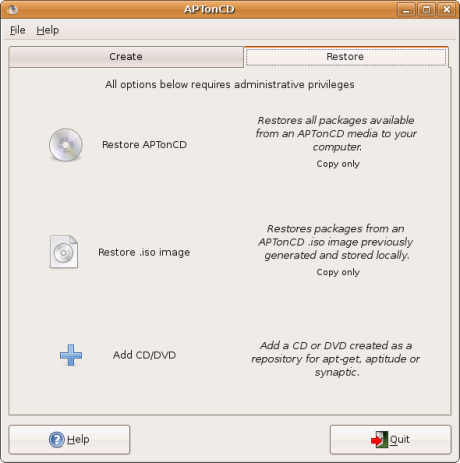
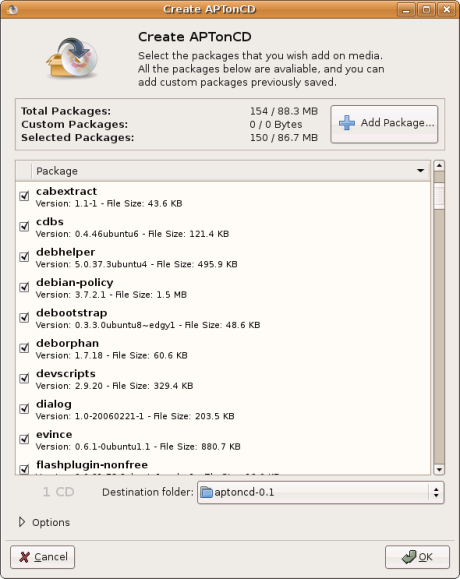
Luckily there’s AptonCD, a GUI application that helps you create removable repository on CD/DVD using packages you’ve downloaded.

AptOnCD, enables you to select specific package that you want to put in removable repository (DVD/CD).

Once created, the DVD can act as a repository itself and you can install software from it using apt-get normally.

apt-get2.pngapt-get1.png
AptOnCD also has feature that can restore/copy all the packages on the target computer, this means you can ‘preload’ the computer with packages from apt-get before you start using it. This can save
your time from having to insert the repository CD/DVD when you want to install a software.

Currently AptOnCD is tested and available for Ubuntu and Debian Linux distribution and can be downloaded here : http://aptoncd.sourceforge.net/download.html

[tags]apt-get,ubuntu,debian,mirrors,repository,synaptic[/tags]

nbsp&;

By using VoIP calling service, you can reduce international calling costs and even start your own VoIP business as a VoIP reseller.

RFC 2324: Hyper Text Coffee Pot Control Protocol

Wonder how I missed this this peculiar RFC, RFC 2324 : Hyper Text Coffee Pot Control Protocol. It was brought out by Toydi a while ago when we were having discussion about REST implementation.

The RFC provides specification for a protocol based on HTTP, which can be use to send signal to a coffee maker appliance which can help people make coffee.

Clearly this is intended as a joke, but it is a well-written RFC which has all the details necessary to build HTCP-compliant coffee maker.

and according to this wikipedia entry, is indeed has been implemented on Emacs and Mozilla browser (through 3rd party patches).

Other Humorous RFC ?
HTCPCP is an example of a well written RFC which is intended as an April Fool’s joke, but it is not the only one produced, please refer here : http://en.wikipedia.org/wiki/April_1st_RFC for a list of RFC written specifically for April Fool’s day.

[tags]humor, funny,internet,rfc[/tags]

Where can i find inittab in Ubuntu Edgy Eft (or Feisty Fawn) ?

I’m sure many of you might stumbled upon this problem when you discovered first hand that there is no /etc/inittab file on Ubuntu Edgy Eft or Feisty Fawn.

This is deliberate because Ubuntu do not use init anymore to manage its services during startup or shutdown of the system. Instead it uses ‘upstart‘ as replacement for the traditional sysvinit utility that is common to Linux-based operating system.

All the things that you used to have in the /etc/inittab is ported to upstart’s /etc/event.d/.

It might take some of time to get used to the way upstart manage things in your computer, For example, the settings for ‘tty3’ is located in ‘/etc/event.d/tty3’ if you need to change it’s parameter, and rc scripts on rc*.

Additionally You can use ‘runlevel’ command to determine which runlevel your computer is in.

Please refer to Upstart Project page if you’re interested to know more about the project

[tags]ubuntu,upstart,init,inittab,linux,opensource,bsd[/tags]

Howto : Make your package updates faster in Ubuntu

Experiencing slow software updates from Ubuntu servers? Why don’t you try the nearest server to your location?

Although Ubuntu default installation already chooses the closest server to you, it is still a good idea to find a mirror located in your country to speed up software installation and updates.

The fastest way to do that is by using the Source-O-Matic tool fromUbuntu-NL website. The service is provided free-of-charge for the benefit of Ubuntu users around the world.

Beside the ‘official’ Ubuntu repository (main, universe, multiverse), Source-O-Matic also lists several popular ‘unofficial’ software repositories for you to put in your /etc/apt/sources.lst file.

Be aware that the ‘unofficial’ repositories isn’t regularly updated with the latest security patch and might break your operating system.

After you’ve done ticking the checkbox, you will be presented with a plaintext display of source.lst file content like this :

# Automatically generated sources.list
# http://www.ubuntu-nl.org/source-o-matic/
#
# If you get GPG errors with this sources.list, locate the GPG key in this file
# and run these commands (where KEY is replaced with that key)
#
# gpg --keyserver hkp://subkeys.pgp.net --recv-keys KEY
# gpg --export --armor KEY | sudo apt-key add -

# Ubuntu supported packages
# GPG key: 437D05B5
deb http://tw.archive.ubuntu.com/ubuntu edgy main restricted 
deb http://tw.archive.ubuntu.com/ubuntu edgy-updates main restricted
deb http://security.ubuntu.com/ubuntu edgy-security main restricted

# Ubuntu community supported packages
# GPG key: 437D05B5
deb http://tw.archive.ubuntu.com/ubuntu edgy universe multiverse 
deb http://tw.archive.ubuntu.com/ubuntu edgy-updates universe multiverse
deb http://security.ubuntu.com/ubuntu edgy-security universe multiverse

All you need to do is save the page and overwrite your current /etc/apt/sources.lst file with the one generated with this tool.

A word of warning
My initial checking reveals that not all servers listed in Ubuntu-NL is hosted in the same country as indicated in the list.

For example, a ‘dig’ to my.archive.ubuntu.com reveals this ip, 91.189.89.8 which is clearly is not a Malaysian ip address (a dig to us.archive.ubuntu.com also reveals the exact ip address).

So its better to double check the location of ip addresses produced by the mirror domain to confirms that the mirror is indeed located near your location before you start using it.

You can confirm this by visiting ShowIP fakap or HostIP services.

[tags]ubuntu, dapper,feisty fawn, breezy, apt-get,sources.lst[/tags]